THE BASIS OF A BOYCOTT POLICY
This committee was born in the wake of the Choices Choices forum, amid a flurry of concern about the incredible explosion of products on the Coop's shelves, and the growing
awareness of the gulf between the stuff we claimed to believe in and the stuff the manufacturers of a lot of the stuff we carried were doing in the world.
This disconnect is most clearly exemplified by Coca-Cola, Nestle,
Horizon,
Heinz, and General Mills, but their notorious
offenses are not the only problem
that these corporations bring to the Coop. The intrusion of "corporate values" into small-scale and cooperative operations has been slow and insidious, and as we look closer and
closer, it looks more and more ubiquitous.
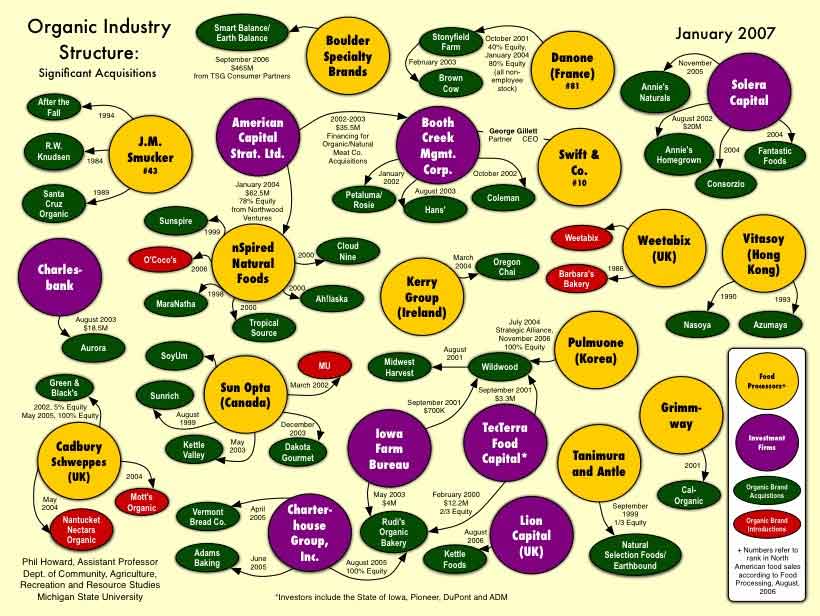
This discussion includes "core values" issues like Fair Trade, local production, and the implications of multinational corporations taking over an ever-growing share of the
small companies and distribution systems that we have traditionally gotten our food from, as well as even more complex issues like
the coop's role in pollution prevention, carbon footprint, unlisted ingredients, and excessive packaging.
THE LANDSCAPE OF THE PROBLEM
In the meetings that followed Choice Choices, there were numerous calls for boycotts and it was observed
that we did not in fact have a boycott policy, and as we looked for ways to organize boycotts of products from companies like Odwalla and Horizon we discovered that we did not even have the BASIS
to support a boycott policy. So the committee began the
laborious process of creating a structural framework to support the development of transparent product evaluation policies that could be applied uniformly and implemented within the organization, That process is ongoing and the work-product and the implementation problems we have encountered are explored below in our
committee's minutes and our posted work products, including the working DRAFT of the product matrix.
One of the problems we
acknowledge, but do not pretend to have addressed is the matter of
holding a company like Odwalla or Muir Glen responsible for the
demonstrably egregious behavior of their corporate owners, like Coca
Cola's death squads in Columbia, or General Mills' role in shooting down
local attempts to impose stricter product labeling laws.
This is 100%
analogous to the problem of you as a shopper being held responsible for
the decisions of the buyers at your coop ... in a tradition that extends at
least as far back as Rochdale Principles,
through this boycott policy we, as member-owners are basically
denying the legitimacy of the corporate veil and stating that it has no
business in a cooperative enterprise.
TAKING EFFECTIVE ACTION
Recognizing that the
development of policies to address all of these issues was truly complicated and that we
were in for more than a few month's work, the committee launched a pair of
direct campaigns to confront apparent conflicts between our core values
and the store's product mix:
-
the first campaign addressed oversights and omissions in the Coop's Policy Governance (POGO) documents. Our POGO - based loosely on
Policy Governance® a management philosophy promoted by John Carver -
was a radical set of documents that has been used to insulate the majority of the Coop's management decisions and operational policies from both its board and its member-owners.
This is a fundamental change in policy that was never voted
on by our membership. The Policy Selection Guidelines Committee's
(PSGC)
purpose and scope explicitly includes
coordination with the the coop's POGO committee to harmonize the coop's historical mission and policy statements with these policy governance documents. Since the board's POGO committee had been
largely dormant since the creation of the Product
Selection Committee, The PSGC took the issue directly to the board and the board voted to tie the two sets of governance documents
back together. This step eliminated numerous
opportunities for contradiction and misunderstanding simply by requiring that operational policies be compatible with the organization's
adopted mission and its principles.
-
The second campaign was a boycott
movement directed specifically at Coca Cola's products, beginning with Odwalla, a
popular product line that drew several "lines in the sand" within the
community, and carried approximately $80,000 in annual
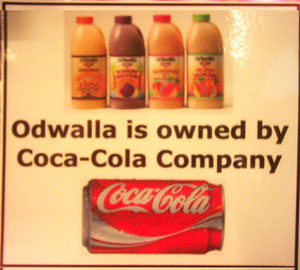
sales. The machine was officially labeled "Odwalla is owned by the Coca Cola
Company" (this had been done previously by activists but the
labeling had been treated by management as vandalism) and then, as
pressure mounted, a poster was added that presented the issues with
links to other organizations actively involved in Odwalla/Coca
Cola boycotts. Finally, the Odwalla machine, which had previously held one of
the prime locations in our store, was removed, at the direction of
the Board of Directors and the poster was revised to recognize
official participation by board and management.
IMPLEMENTING A BOYCOTT POLICY
The committee completed a
DRAFT boycott policy for submission to the Coop's Board at the September 2007 meeting for board review and adoption.
In Fall 2009 the first Boycott request was presented to the Board, initiated by Board Member and original Product Selections Guidelines Committee (PSGC) Board liason Janet Welch. The target of the Boycott request was Dean Foods WhiteWave Silk Soy creamer replacement products.
What had occurred was Dean Foods had swtiched from Organic to Conventional Soy in the majority of their products. Per the Food Co-op's Adopted Boycott Policy, the affected products were posted with notice of the Boycott investigation ("There will be an educational posting next to the product(s) in question informing the members of the proposed boycott, clearly stating the issues involved"), and a request went to Operations and to the Product Research Committee. Operations researched probable financial impacts and available replacement products, and PRC researched the claims and the issues. There was overlap in these investigations.
Operations predicted substantial finacial impacts would result if all WhiteWave Silk products were removed from the store And during the course of discussions with PRC, Operations began phasing out the Silk prodcuts for which replacements were available. PRC determined that there was in fact a "Bait and Switch" going on. At the time of the investigation, the Silk website promised Organic soy tested to assure that the ingredients were for non-GMO. In late 2009 this changed, and Silk apparered to have entered into a financial replartionship with Conservation International to greenwash their new international soy sourcing program. This has led to the replacement of the original advertizing material with more nuanced and less contradictory advertizing materials which state: "All Silk soybeans – certified organic and those naturally produced without the use of genetic modification (GMO) – are currently sourced in North America.": Unless one is a hardened skeptic, it is easy to miss the subtleties of Dean Food's new marketing statement. Translated it means: "only those products labeled organic (almost none of their products are now labeled organic) are made with North American sourced Soybeans AND not all their organic beans are certified non-GMO and vice versa."
The Dean Food Boycott Proposal led the PRC committee and Deb Shortess, our committee's liaison with Operations, into some very murky water. If the Co-op were to apply the standards that Operations and the PRC were now discussing involving products with ingredient switches from certified organic and/or non-GMO to the less regulated and less stringent "natural" adjective, the Co-op would be in deep trouble with our bottom line AND with our customers. The committee therefore opted to accept the strategy proposed (and already underway) by Operations to sunset all non-organic Silk products for which replacements were available, and to find replacements for those for which we did not have ready replacements within the distribution chain.
The carefully-worded boycott proposal submitted by Welsh had focused on the issue of deceptive advertising by Dean Foods and had not called for the expulsion of all products from companies who were betraying the organic industry by substituting "natural" ingredients for certifiably "organic". Nor did the proposal itself delve into the Co-op's position regarding the creeping erosion within the foods industry of replacing Organic ingredients with "natural" products--natural--a meaningless term that appears to have comparable retail cachet to organic.
The limitations imposed by the wording of the boycott proposal along with issues regarding an increasing use of the less stringent designation of "natural" were presented to the Board. In addition, the joint reports from Operations and the Committee suggested that the boycott should be dismissed because the proposal (as written) had focused on the deceptive marketing practices aspects, and Operations had assured the Committee that they had been well-informed of the changes, had not received any deceptive promotional materials, and had not sold any mislabeled Silk products.
In addition, the Committee suggested that a letter be written to Dean Foods and informing the company our boycott investigation and the membership's dissatisfaction with the retreat from organic standards through the substitution of the misleading labeling of conventional agribusiness products as a "natural". Board Members voted not to impose the boycott. Board member, Dan Goldstein, volunteered to draft a letter of complaint from the BoD to Dean Foods and to our distributors from the BoD.
|
|
PROBLEM PRODUCTS BOYCOTT POLICY

Sign the
Teamsters' Petition
PRODUCT COMMITTEE DOCUMENTS
|
DEVELOPING THE EVALUATION TOOLS
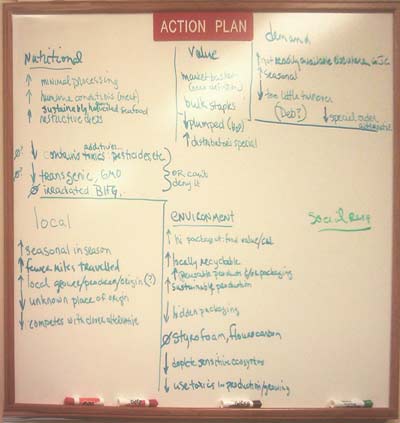
This Action Plan provided the beginning of the Product Matrix development project. The Matrix provides a structure, a methodology, and a set of tools for evaluating the match between product's characteristics and
the coop's values.
Ultimately, the process creates a rating system very similar to the ones shoppers are familiar with from Consumer Reports, the Crutchfield
Catalog and other "features based" or "criteria based" research summaries. The Matrix is a tool for evaluation the match between the product and a set of criteria
derived from the Coop's Mission Statement and the statements of values that the members adopted many years ago.
TEST DRIVE/REVIEW THE MATRIX TOOL |
The 'COOP of COOPS' CONTRACT

Imagine turning organizations like CGIN into something
a little more USEFUL
to Coops trying to find COE corporate ownership, and other product information.
Let's do it!

We belong to the National Coop Grocers Association, the source of
those Co-op Advantage mailers and instore pricing specials. Let's leverage our membership in
the NCGA into a consumer advocacy machine that can form
an alliances with biggies like Whole Foods
(which already dictates to our distributor UNFI what ingredients CAN'T be
in the products supplied to WFM.) This is a way to take on corporate food moguls
that put Muir Glen tomato products in epoxy lined cans on our shelves. |